Rama Duwaji's Wardrobe and how Fashion is Inherently Political

Updated: Jan 24
Written By: Joan Sim


Women’s fashion is not merely for glamour. It is treated as a public statement, a message issued before one has the chance to even speak. Men, by contrast, are seldom pressured to experiment with their appearance or justify their clothing choices; their wardrobes are often perceived as neutral, practical, and unremarkable. This allows men to dress with minimal deliberation and little consequence. Women, however, are continuously scrutinised through what they wear, even when their choices are involuntary or incidental.
A woman’s clothing is frequently interpreted as a reflection of her character: prim and proper, skanky and frivolous, old-fashioned and outdated, or conventionally attractive and desirable. Entire identities are projected onto pieces of cloth. Women are judged not only for what they say or do, but for how successfully they perform acceptability through fashion. And yet, fashion as a public statement has also long been reclaimed and utilised by women.
This double standard became evident on 1 January, when New York’s new democratic socialist mayor Zohran Mamdani was sworn in alongside his wife, Rama Duwaji, a 28-year-old artist and animator. Public attention fixated on her black leather Miista “Shelly Boots,” retailing at around US$630. Critics accused Mamdani of hypocrisy, arguing that such footwear contradicted his affordability platform. It was later clarified by her stylist, Gabriella Karefa-Johnson, that the boots were rented. But by then, the damage had already been done. The outrage revealed less about economic policy and more about how quickly a woman’s body becomes a site for political projection.
However, her wardrobe is also often intentional. One notable piece was a custom coat ordered and paid for by Duwaji, designed by Palestinian-Lebanese designer Cynthia Merhej of the label Renaissance Renaissance. According to an administration spokesperson, the coat was a bespoke version of a runway look. Karefa-Johnson explained: “On her first official day as First Lady of New York, Rama is wearing a small, independent woman designer from the Middle East. That representation resonates. It reverberates. Because fashion communicates. It sends a message.”
Duwaji’s outfit was not accidental. It was a quiet assertion of belief, a non-violent statement that mirrored her (and her husband’s) political values and used visibility itself as a form of resistance.
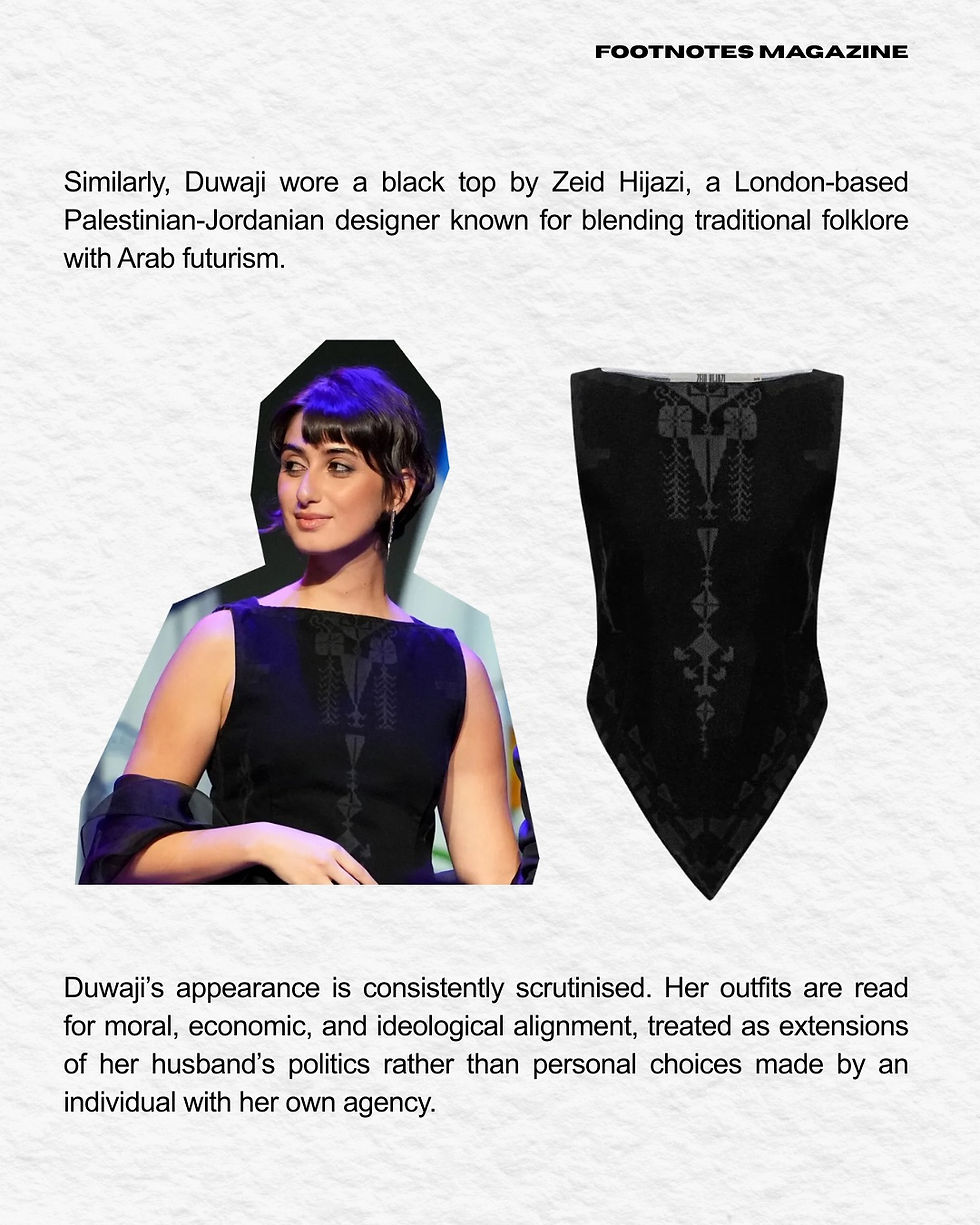
Similarly, Duwaji wore a black top by Zeid Hijazi, a London-based Palestinian-Jordanian designer known for blending traditional folklore with Arab futurism. Made from laser-etched denim with a high neckline and basque waist, the piece carried cultural intention rather than mere aesthetic appeal. The design embedded history and identity directly into the garment.
Duwaji’s appearance is consistently scrutinised. Her outfits are read for moral, economic, and ideological alignment, treated as extensions of her husband’s politics rather than personal choices made by an individual with her own agency.
The pattern noticed is, women near power are rarely allowed neutrality. Clothing becomes a site of judgment, turning fashion into an unavoidable political language. What she wears is not simply style, but meaning imposed.
In that sense, fashion is never just fashion.


Comments